Multiplication games for 3rd grade
Teach it in this order: equal groups, repeated addition, arrays, then the facts. Give each step its own activity and run one a day with the whole class. The Wordwall community has teacher made games for every step, and any of them will also print as a worksheet.
= 12
Why third grade multiplication stalls
Most children can chant 5 times 3 before they can show you what it means. The chanting arrives first because it is easy to drill, and then it collapses the moment the question is worded differently or the numbers get bigger.
The fix is not more drilling. It is making each stage visible before moving on, so a child can put their finger on a group, a row, or an array and say what it is.
The order to teach it in
- Equal groupsFour plates, three cookies on each. The child counts the groups, not the cookies.
- Repeated additionThe same picture written as 3 plus 3 plus 3 plus 3. This is where multiplication becomes shorthand rather than a new idea.
- ArraysRows and columns. The step where 3 times 4 and 4 times 3 stop being two separate facts to memorize.
- The factsOnly now, and only in small sets. A child who has done the first three steps is recalling something they understand.
This sequence is one common way to order the topic and matches how most US curricula introduce it. It is not the only way, and no single study is being cited here.
Activities for each step
All made by teachers and published to the Wordwall community. Open one, press play, put it on the board.
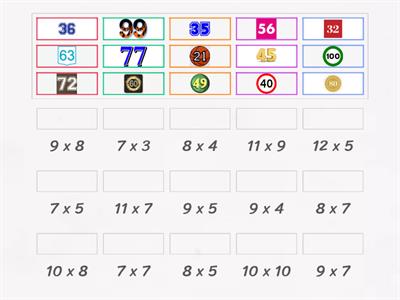


More on the multiplication tag page, filtered by grade.
Which one, and when
Warm up, whole class
A spin the wheel or an open the box. One screen, no devices, 5 minutes, everybody answering at once.
Independent practice
A maze chase or a whack a mole. These reward speed, so they suit the facts stage rather than the understanding stage.
On paper
Any of them will print as a worksheet, which is what you want for homework or a cover lesson.
Frequently asked questions
What age is this for?
Third grade in the US, which is where multiplication is formally introduced, and the first half of fourth grade for children who need the earlier steps again.
Do I have to use the whole sequence?
No. If your class already works confidently with arrays, start at the facts. The sequence matters when something has gone wrong and you need to find out where.
Can I change the numbers in these activities?
Yes. Open any activity and edit the content, or copy it and make your own version with the numbers your class needs.
Build it with your own numbers
Type in the facts your class is working on and the activity is ready. The same list becomes a different game next week, or a worksheet.